
• The forum software that supports hummy.tv has been upgraded to XenForo 2.3!

    Please bear with us as we continue to tweak things, and feel free to post any questions, issues or suggestions in the upgrade thread.

How to transfer files from defunct HDR FOX T2 to view on HDR 2000T?

I 'may' have succeeded in copying the files, using the Humax native opt+ command.
It will be very slow, the decryption on the HDR Fox T2 is slow and the USB ports are even slower.
I couldn't access or see the files via 'Video' as the screen just went blank every time I clicked on Video.
That's because it's trying to access the internal hard disc, which is not present. You may be able to press Blue on the remote to change which media it is looking for, select USB.
However, I could see the files via 'Music'.
Presumably Humax thought that 'Music' might be people playing files from USB sticks.
I currently have the Humax hard drive via USB caddy in the 1st USB port and a 64gb usb drive flickering away in the 2nd USB port, which 'seems' to be copying a large file I marked for copying. It is taking time.
I will report back.
The question is whether the file has been decrypted or not. If it is an HD recording it probably won't be, if SD hopefully it will.

What format is the 64GB drive in? If FAT32 then any file above 4GB in length won't fit, I can't remember whether the HDR Fox T2 just truncates it or gives an error. SD recordings of an hour or less in length will fit in 4GB. I can't remember where HD files land size wise but I have a vague memory an hour is around 4GB though it may be less these days as the broadcasters reduce bit rates.
 
Last edited:
This should work, on a working system, if the caddy is not expecting to power the HDD from the USB port (which can only provide sufficient power for a 5V-only "portable" HDD). But with a dodgy system there are too many unknowns.
Agreed. The important question is does the caddy provide 12V power for the 3.5" hard drive. There have been problems in the past where people trying to use a caddy didn't understand the need for a 12V supply.
 
It's moot. He wouldn't have got this far if it didn't.
That was my thought too. To be able to select a recording, press Opt+ on it and copy it to the other USB interface, and see the LED flashing on the 64GB USB stick, the USB caddy for the original Humax hard disc must have a 12V supply connected.
 
It didn't work. I left the 64gb Toshiba USB drive flickering for 8 hours! I then tried another 64 gb USB drive with no success. All the recordings were SD.

Sorry folks I'm giving up.

I am happy to end this thread.

Thanks to everyone.
 
Many thanks Owen, but I have spent too many wasted hours on it already.

Our 2000 seems to be a good replacement. As I said it was new and unused. If it was to fail I think I would move away from Humax despite the 14 years service I have had.

My wife has come to terms with the loss of her recordings. The reality is that she was happy knowing they were stored and available, but didn't really view them.
 
Whilst there appear to be options for the recovery of your wife's recordings in the HDR-FOX-T2 (keep the Fox disk as-is in case you change your mind about recovery) those options do not exist for the 2000T. We do not know how to find the encryption key. Therefore if you want to keep standard definition recordings made on the 2000T long-term I would suggest you archive them to an external USB drive using the 2000T's copy facility. The act of copying decrypts the recordings. Then should the 2000T fail you won't have the same dilemma.
Note: copying to USB can be incredibly slow. Patience required!
 
Many thanks Owen, but I have spent too many wasted hours on it already.
I get the feeling you spent a lot of time thinking it was an HDMI sync issue and working to resolve that, when unfortunately that was wasted effort as that wasn't the problem at all. Asking here would probably have revealed that sooner.
 
You are absolutely right Owen.

Yes that's a good tip EEPhil. It seems that in the not-too-distant future 'they' are moving us to online transmission only, possibly with no recordings, as that opens up a source of revenue. Archiving recordings from the 2000 may therefore be handy for future viewing, if there is anything worth archiving of course! I didn't have many.
 
Black Hole.

You said: "Booting a PC to run Linux from USB is straightforward (there are plenty of instructions available), and running the Stripts utility (decryption tool) native in Linux is straightforward. Modern Linux desktops are sufficiently Windows-like to cause no trouble, and the process requires no additional hardware (such as the purchase of another HDR-FOX). All it requires is the will, and the MAC and serial number from the original HDR-FOX (which are on the product label)".

I am willing to give it one final go. I have the MAC and serial number from the original HDR-FOX (which are on the product label). Can you provide the 'straightforward' instructions or reference link on how to use my mini Windows 11 PC to decrypt the FOX HDR T2 hard drive, which is currently in a USB Caddy?
 
Bugger that. It would take me a lot longer than actually doing it.

Step by step instructions are impossible, exact procedure will vary according to what actually happens on your particular set-up. All I (or anyone) can provide is a basic procedure outline which you will need to use a bit of intelligence when following... but Google is your friend. It's hardly rocket science, the hard work has been done for you by providing the decryption utility and instructions for using it. The basic procedure is already published where I have pointed you before: https://hummy.tv/forum/threads/hdr-...rs-to-stop-working-entirely.10447/post-159089. All you have to do is read it!

Useful Additional Information (which I googled, as could you have done)

How to prepare a boot USB for Linux Mint

srtripts utility

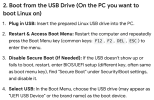
Boot your PC to Linux. Google's AI summary says this:

1764955250469.png

If you get stuck, just ask.
 
Like I said, explicit foolproof step by step instructions are difficult and time consuming to write. And something will inevitably be different on a different PC.
 
Last edited:
Thanks for taking the time to provide the links.

For someone not from a computing background and who hasn't used Linux etc it still doesn't look 'straightforward'.
It looks like it is going to take me some time to pull all the bits together, digest, then tinker around with it. You are correct I could have trawled the site for the various pieces of information. My expectations of finding a Humax site with all the steps laid out for a typical scenario by someone who has done something the same or similar were obviously too optimistic. I will leave it until I regain some enthusiasm.
 
I was curious earlier when you said you could read the disk using your Chromebook, so I've just tried it.

Using my chromebook I can read the files from the disk when attached to the USB and copy them to a windows share on my PC.

It's fairly easy but the big essential is that you have a working home network and the chromebook and mini PC are both on the network, wifi or ethernet.

Edited to add: decryption on the PC using stripts was 45 seconds for 2GB SD recording, quick and simple
 
Thanks for that info hjug.

Yesterday, a search on AI said that Humax did not introduce encryption until 2014, so my 2011 Humax Fox HDR T2 didn't need to be decrypted, including any HD files. AI can get things wrong, so I don't yet know if that is the case; I haven't had time to try it. It may be interesting to try if your Humax is pre-2014. A few days ago, I connected the USB caddy to an Android box, and VLC could see the files but not open them.

I don't have time today or tomorrow, but I will try what you did. I am not networked, so that is something new I will have to figure out and set up.

After reading your post and considering the AI info, in the first instance, I might try copying a file from the USB caddy to a folder in the Chromebook, then across to my mini Windows PC. I read somewhere that simply the act of copying over a file decrypts it. I am maybe barking at the moon here!

Did you find stripts easy to set up on the PC?
 
Yesterday, a search on AI said that Humax did not introduce encryption until 2014, so my 2011 Humax Fox HDR T2 didn't need to be decrypted, including any HD files. AI can get things wrong, so I don't yet know if that is the case; I haven't had time to try it. It may be interesting to try if your Humax is pre-2014. A few days ago, I connected the USB caddy to an Android box, and VLC could see the files but not open them.
As is usually the case, AI is completely wrong about this.
 
I read somewhere that simply the act of copying over a file decrypts it. I am maybe barking at the moon here!
Only if you use the copy facility on the original Humax. So, in your case, your original defunct HDR-FOX-T2 would need to be working to be able to copy from the original disk to an attached USB device That would decrypt standard definition recordings. As your HDR-FOX-T2 is bust and your disk is attached to something else you can't just copy. You will also need to decrypt - hence stripts.
 
Back
Top