Assume v. Presume

If we are to be that pernickety then there is an argument that plug should only be used to stop a gap such as bath hole to prevent water leaking out (or in for other contexts).

Male / female connectors should be the preferred nomenclature though I have a sneaky feeling that the use of male / female like this is now proscribed..
 
Last edited:
Male / female connectors should be the preferred nomenclature though I have a sneaky feeling that the use of male / female like this is now proscribed..
That'll ruin an episode of QI. You can no longer answer the question "what is the favourite tool of a Lesbian builder?" with the comment "a female to female hose augmenter". (The supposedly correct answer being that builders on Lesbos like a bendy rule).
 
If we are to be that pernickety then there is an argument that plug should only be used to stop a gap such as bath hole to prevent water leaking out (or in for other contexts).

Male / female connectors should be the preferred nomenclature though I have a sneaky feeling that the use of male / female like this is now proscribed..
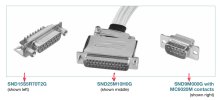
So that then leads to the problem of computer D series connectors where the bit with the pins is the female, and the mating side is the male - but people do not believe you saying the bit with pins is male until you point out how the connector shroud encloses the mating connector. Probably the biggest misuse of male and female connector descriptions around.
 
So that then leads to the problem of computer D series connectors where the bit with the pins is the female, and the mating side is the male - but people do not believe you saying the bit with pins is male until you point out how the connector shroud encloses the mating connector. Probably the biggest misuse of male and female connector descriptions around.
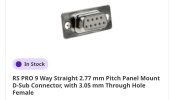
The RS catalogue doesn't agree with you.

1779089966427.png

...and I have always used M/F to refer to the pins and sockets. Good luck ordering parts and getting the right thing.

From Wikipedia (not that I consider it authoritative):

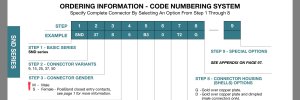
D-sub connectors have gender: parts with pin contacts are called male connectors or plugs, while those with socket contacts are called female connectors or sockets.
 
and I have always used M/F to refer to the pins and sockets. Good luck ordering parts and getting the right thing.
So have I. Even better try getting the correct gender changing component without referring to M-M or F-F. (I suppose you could say socket-socket or plug-plug)
 
We appear to have lost the battle with "plug socket" even though it's illogical. Is the recharging port on your phone a plug socket (it's a socket that you plug a cable into)? What about an ethernet port that receives an rj45 cable? Plug and socket again, so "plug socket"?
I use either "mains socket" or "13A socket". I refuse to use "plug socket".
 
mains socket
^ This.

I was waiting for my order at the fish & chip shop, and the younger chap next to me watched me rip through the quick crossword, and commented that kids these days wouldn't have a clue. We discussed that they get all their language from social media influencers, who don't have the slightest grasp. "Plug socket" is one of those type of inanity, much like "train station" (sorry!).
 
The RS catalogue doesn't agree with you.

...

...and I have always used M/F to refer to the pins and sockets. Good luck ordering parts and getting the right thing.

From Wikipedia (not that I consider it authoritative):

Yes, that is how they are commonly described, but then go back to the manufacturers data sheet and you find it the opposite.

Here is a Positronic data sheet (warning, sizeable download) which does describe the connectors as male and female - but you have to search to find which is which. Go to page 7 and look at the dimensions B, B1, D and D1.

Other manufacturers carefully avoid the m/f designation and go with plug and receptacle.

People do assume that having male pins makes it the male connector but it ain't necessarily so ... as the song goes.
 
Yes, but...

You are talking about the housings. If you look at page 1 and (eg) page 81, you'll see they also talk about male and female contacts (the male contacts – pins – are loaded into female housings, and vice versa.

I can't find anything in that datasheet to contradict that as a complete connector, the male has pins.
 
Just be glad they did not ask for an adapter adaptor.
There was only one person.
I was just glad to get out alive. After the initial "What?", it took me a few moments to realise what he'd done.
He'd run out a cable, having socket-plugged it into one of the inputs instead of the output, and then he tried to socket-plug his kit into the end and found he had a socket-plug to socket-plug, hence the request for a plug-socket to plug-socket adapter. Quite how he thought mains arriving at his end on pins was safe was beyond me, but that's $plumbers for you.
Having twigged, I told him to bring his cable end towards me and I took the end he'd previously socket-plugged in out again and we'd meet in the middle. We exchanged ends, he socket-plugged his kit into the plug-socket end and I socket-plugged the correct end of the cable into the plug-socket output and switched on. He was then happy and mumbled something to cover his embarassment.
It was the day I met Charles and Diana (no, not the P's of W). I never saw the $plumber again, thankfully, nor the aforementioned.
 
Last edited:
$plumbers
It amazes me that gas fitters seem to be electricians, plumbers appear to be electricians, electricians are gas fitters and plumbers. Yes it's good that they might be multi-skilled (and, hopefully, members of gas-safe and NICEIC), but most don't seem to know one end of a screwdriver from the other. It's no surprise they need an "adapter adapter". 🔧
 
It amazes me that gas fitters seem to be electricians, plumbers appear to be electricians, electricians are gas fitters and plumbers.
Yes, except mine (for boiler replacement) wasn't. He expected to just take the old one off the wall, hang the new one on the wall, connect it up and bugger off, all in a day and charge a grand for it (plus the cost of the boiler etc.). Needless to say, it didn't quite go like that. I knew things were going badly when he announced just after he'd started taking the old one and the flue out that he wasn't a brickie. So how exactly did he think he was going to complete the job? I had a big hole in the back of the house for 2 days.
Turns out he wasn't an electrician either. It's a complete and utter effing nightmare of an installation. It didn't help that the original boiler was bodged by (presumably) the builders, and the original electrics which went diagonally down the wall (and of course he the drilled right through the cable, "# ...and out went all the lights.").

In the previous post, $plumber was a euphemism for another trade, but probably fitting for how electricians regard plumbers. In this scenario, I was the $electrician.
 
Back
Top