EV chat

Curious what the counterpart story will be for battery stuff. Not that I know what a good alternative is.
That will be interesting to hear. When they realise that we can't afford the huge costs involved in infrastructure (required for the charging points, electricity network & generation), the massive hikes in insurance cost (already happening for EVs as a damage to the battery housing may cause a "write off" status or at least a replacement battery) and the inability, certainly at the moment, to be able to recycle the components as well as the cradle to grave environmental cost.

Oh, of course who exactly do you think will be paying for all this one way or another - YOU 👈
 
Well, people are missing out on a nicer driving experience. Of course die-hard petrol heads will only be happy with the theatre of the noise and gear changes - but for most drivers the gearless (like automatic, but smooth power all the way) is a great experience, as is the general tranquillity. Just over the road from me is a household with two cars: A Fiat 500 dressed up as a noisey "Abarth" and a large SUV like Porsche. Both make a din - horrid!
A neighbour a few doors along used to joke about our EV (he had some sort of big old jeep type thing. He got fed up of the MPG and cost of fueling, so he bought an electric Renault 5 and absolutely loves it. He now understands why I told him that one day he would buy an EV and he would discover how it would put a smile on his face when he drove it.

Complicated - No. I park, plug in. Sleep. Unplug. Yes that means the terrible inconvenience of having to park outside (or near) my home twice. So hard 🙄
have to find a rapid charger that is available and working
Find one which is working - not a problem. The rapid charging networks have altered dramatically in the last few years, but the same old stories get recycled. I know of a few operators which I wouldn't trust, like Genie Point. An EV forum which I read asked if anyone had any bad experiences this Easter - So far the verdict is "no". There are now more "hubs" with multiple units which are meeting the demand. Coupled with cars now having much greater ranges than 5-10 years ago means people are needing a rapid charge less often.
Price can be disappointing though.
Price/value is a genuine complaint. Many people who home charge seem to take a very casual view of being over-charged for rapids which they only use occasionally, on a longer journey. That really doesn't help those of us who pay the higher price of standard (not rapid) public charging. As more people use EVs the marked competitiveness will improve.
You do realise that over time, perhaps a bit beyond 2030/2035 there will be filling stations closing because of reduced trade and the tables will be turning with ICE drivers needing to use apps to find where the filling stations are and check the prices! Meanwhile the "fuel" which reaches every point via wires will just be there.
Does yours really do 250 miles between charges, or was that only when it was new and the wind was behind you?
WLTP is actually ~280 Realistically over 250 spring-summer-autumn. It could be as low as 230 miles on the coldest winter days with wet roads. Only some of that drop is battery related. ICE also suffers from the extra work of turning tyres through wet surface.
If we are trading "not so performant" examples: an ICE in slow traffic & around town is in lower gears and consequently considerably under-delivering on stated range, particularly when the engine is running and going nowhere or going uphill in a lower gear. An EV in heavy traffic is using little energy and the air drag has gone (just like for ICE) so the efficiency is actually higher than the WLTP. Besides being a wonderfully smooth driving experience up and down hills, I get to see the range go up as I descent long hills - do you ever get petrol back into your tank after using extra for the hill climb? There's a hill which I regularly encounter where the car shows it has put back 5 miles of range on the descent. Of course, it took more energy to climb in the first place, but the combustion engine also works hard in a lower gear to climb, but you get nothing back on the descent.

There is absolutely no comparison between mobile phone battery performance and cars. Car have a "battery management system" which can actively cool the battery. Phone manufacturers have historically been keen on the dual benefit of maximising the stated run-time (charging to highest possible level and discharging to dead flat) and the fact that it harms the battery builds in useful rapid failure to sell you a new one! That said, in the last few years some mobiles have done something to help the life of their batteries, like no longer charging at maximum speed to 100% when you connect to a charger at bed time, then spending the rest of the night keeping it pumped to 100%. My Google Pixel charges slowly to 80%, then holds at that level until nearer my get-up time and finishes charging to 100% in time for me to want it. Phones also have no cooling for the battery which, like laptops working hard and on mains, may get quite hot. Most batteries like 30C, but not hot to the touch. Most of the FUD around EV cars stems from the sort of early ~2010 models which had no cooling at all or air cooling. Aggressive driving, perhaps mixed with some rapid charging over heated their batteries. That was worse in hotter countries than the UK, but FUD doesn't respect geography.

Top Gear study of battery degradation (sorry site won't allow me to post external links still, so copy and edit the link): h-t-t-p-s://www.topgear.com/car-news/electric/a-new-study-has-revealed-electric-car-batteries-last-a-lot-longer-you-think
The bottom line from that article...
It's pretty clear that normal private drivers who charge overnight will find their battery deterioration rate very much at the low end of the spectrum. An average mileage car, charged mostly at home, would likely be at a solid 90 per cent capacity after 10 years.
Now the broad-brush objections:
There is also some serious doubt as to the whole life cost to the environment of EV vehicles versus ICE vehicles, which seems to be disregarded by the powers that be. So whilst you may feel quite smug with your zero emissions at point of use that is nowhere near the whole story! Then there is the cost and upheaval of updating the distribution network - for example a very popular holiday park in my area tried to prepare for the future by requesting the installation of six charging points with the supply provided by Western Power Distribution - their answer - we might manage to provide two from the current network! Obviously such updates to the distribution networks involve costs which, no doubt, will be paid for by all customers of the network and NOT just EV owners - think Smart meters, Green levy, Renewables, Wind Power etc. etc. - we have been paying for these without necessarily being told about it or the extra additional cost to our bills it involves
"Some serious doubt" is doing a lot of heavy lifting!
No - There's a very skewed way of looking at things involved in the making of an EV s (and batteries in particular) which chooses to examine the "inputs" to manufacturing the car (fair point), but chooses to ignore the negative inputs of the fuel extraction and refining. For example a lot of cobalt is used in refineries. People would quickly defend the cobalt in refining as it gets recycled... so too are batteries.

Regarding power distribution/infrastructure: I made a point earlier about how EVs are actually a useful resource to the National Grid because they can be used to flatten the daily demand curve (see below). If drivers choose, or are nudged by prices, to charge when power is plentiful and don't when it is not, it helps the grid, by not having to view EV charging as a load which pushes their peak demand up over the years. Apparently the UK demand for electricity has been dropping over the years due to greater efficiency of equipment. lighting etc. Only recently has it begun to nudge up. Most of the grid reinforcement is because it was designed to distribute power from the traditional big coal powered stations, then later more gas ones. They were built around heavy industrial or coal areas. Now we have power coming from the edges, like off-shore wind or rural solar. Lots of power from around Scotland is providing a problem getting it down to the south and southwest.
Some homes which have an EV charger also have it tied into a clamp which monitors the total house current drawn. This ensures that if you run everything at the same time the car charging doesn't exceed the supply to the home.
Something like a holiday park is often out on a rural limb, with pretty views and just about getting the power it needs from the overhead power cables. Outside of the time when the public areas, cafe, restaurant, bar laundry etc are running there would probably have been enough power. People (and that includes the Distribution Network Operators) have not become very tuned to balancing electricity use.
The shame is that the holiday park could probably have had 6 chargers if it were either possible to make 3 of them 24/7 and another 3 off-peak only.

BTW so as not to look too much like I hate all oil... I recognise the many uses it has, it's great stuff, a brilliant asset as lubricants, plastics all sorts of products, many of which can be at least partially recycled - We should value it more, so what seems so silly is to be burning the stuff, then it's gone. Of course it is difficult to change, but we really can't just stick our heads in the sand. There really is a cost to doing nothing. The homes which are un-insurable because of flooding are among the first victims. Problems with crops are on the horizon. Large scale fires.... I mean maybe it is acceptable to some to think that the elderly and the poor in tower blocks will die from heat exhaustion or hypertheria - Do they think it is a beneficial saving for the state - not my opinion. But there's the cost. Yes it's a global problem. We can't all sit on our hands, nor does it make financial sense not to act.

Why do I say that? Well, it is very easy to just hit out at the move towards renewable energy and speculate at the costs and ignore the benefits. I guess a lot of people are on price-fixes for their energy. That hides a lot of things. It hides the pleasure as well as the pain.
Today my electricity is costing 15.24p/kWh, yesterday it was 17.38p - Tomorrow it will be 9.41p/kWh (all day)
This is because I am on a "tracker" tariff, so I see how much the cost drops when there is a lot of wind and low demand (because of weekend/Easter holiday in part). When we are getting a lot of power from gas and the least efficient power plants having to be run-up the price goes much higher. I am really am exposed to the reality of lower cost renewables and the higher cost of burning natural gas. It doesn't matter whether it comes from the USA or Qatar or the North Sea, it is sold commercially by the oil companies on the global market and the prices fluctuate, but it certainly won't be any cheaper to get less being burned means cheaper electricity.

I'd finished, until I caught up with latest posts...
When they realise that we can't afford the huge costs involved in infrastructure (required for the charging points, electricity network & generation)
The EVs are not going to be the problem for grid at all. The grid restructuring is more about the change in where the power is created and where it continues to be consumed. Maybe data-centres and AI present a challenge because they are 24/7. EVs are not 24/7.
You don't have to take my word for the facts about UK demand. Here's a link to NESO (National Energy System Operator)
The NESO Demand Curve - sorry another external link to edit in order to view :-(
h-t-t-p-s://www.neso.energy/data-portal/1-day-ahead-demand-forecast/demand_curve_-_sample
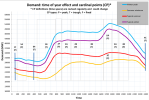
1775310747814.png
The grid has to be able to supply about 52 GW for the evening peak in "average" winter, higher when it is very cold.
You can clearly see that overnight the "spare" capability of the grid is something like 52-31 = 21GW (in winter, more in the other seasons)
Other people have done the working, so I'm not going to, which says there is no problem charging EVs because so much of the charging of them is done when electricity is cheaper and that is when "time of use" costs are reflecting things like reduced demand and renewables being the source rather than gas.
"Flattening the curve" is the name of the game. Use capacity when it is spare and better still cheap.

 
Last edited:
Well, people are missing out on a nicer driving experience. Of course die-hard petrol heads will only be happy with the theatre of the noise and gear changes - but for most drivers the gearless (like automatic, but smooth power all the way) is a great experience, as is t

Well said. Having had an EV now for 12 years, I would not go back. We have driven the 990 miles home from in S Europe in one day on several occasions (2 of us sharing driving), with nary a worry about charging.
Predictably many of the stories about issues are from surveys for oil companies (for one of which I worked for 10 years), and quite a few people remember the Top Gear program which showed the stars pushing a Tesla back into a garage with a flat battery. In the subsequent court case the judge held that the program was only ever meant to entertain, not to be rigorously fair, and therefore he disregarded the fact that the car had been driven (off screen) until the battery was almost flat.
 
Twice a week, if it really has that range, and probably more because the "empty" will occur at an inconvenient place otherwise. Does yours really do 250 miles between charges, or was that only when it was new and the wind was behind you?
And is that in summer or winter? What is a realistic winter range when temperatures are (say) <10C?

[edit] answered in a later post to the one I was quoting [/edit]
 
Last edited:
As i said previously - just too complicated so I will keep my head in the sand for now.

I can't imagine a nicer drive than my current Kona N, with 280bhp, loud exhaust, superb handling, 8 speed DCT (smooth changes) ++++ many other frills!

It's the most fun I have ever had in a car, well at least whilst driving! 😁

Quite frankly I can't be bothered anymore - I have given my thoughts, for what they are worth, I still think it is "cloud cuckoo land" -END OF
 
Well, people are missing out on a nicer driving experience.
That depends what kind of driving experience you call "nicer". If that's the kind of "nicer" you want, I guess you're the sort who regards driving as an inconvenience and are first in the queue for a self-driving car. Of course, ones experience of driving is coloured by living in a metropolis!

I have spent an (unwanted) weekend with an EV, and I hated it. Control has been ripped away from the driver, driving has been de-skilled (not a great idea to my mind, drivers should be skilled or not on the road at all). Any "aids" I didn't want and that could be turned off got turned back on the next time (and now are mandated not to permit turning them off at all). The very idea that a car should get shirty just because you dare to change lane without signalling, even when there's nobody else around, is absurd... but it would even mistake shadows for lane markers and get shirty about that too.

Do you really want a car mistaking the speed limit and forcing you to do 30mph on a motorway, or even worse be in some kind of automatic mode and accelerate to 70 in an urban area? I know I don't!

Drivers will understand the following, and it will remain a mystery to those for whom a car is a utility for getting from A to B because there is no other way: ICE vehicles with automatic gearboxes are crap because the gearbox reacts to demand and cannot anticipate demand. EVs are crap because you have only one gear and cannot match engine braking to the situation. If you are nose to tail in a traffic jam all day, none of that is relevant and an EV is almost certainly the most suitable.
 
As a cyclist I know when I'm cycling behind a diesel from the exhaust smell, it's disgusting stuff. It's a huge shame that diesels were ever put into passenger cars.
I would have a lot more respect for cyclists if they filled the extra lanes taken away from motorists... in all weathers. Don't get me started on cyclists who think it's OK to be dressed in black at night with no lights.

Councils are hell-bent on promoting cycling (etc) over vehicle use, but fail to consider that the last thing an OAP can do is bring home their weekly shop with a push-bike. Councillors promoting these schemes should spend a year without a chauffeur-driven limo first.
 
That depends what kind of driving experience you call "nicer". If that's the kind of "nicer" you want, I guess you're the sort who regards driving as an inconvenience and are first in the queue for a self-driving car. Of course, ones experience of driving is coloured by living in a metropolis!

I have spent an (unwanted) weekend with an EV, and I hated it. Control has been ripped away from the driver, driving has been de-skilled (not a great idea to my mind, drivers should be skilled or not on the road at all). Any "aids" I didn't want and that could be turned off got turned back on the next time (and now are mandated not to permit turning them off at all). The very idea that a car should get shirty just because you dare to change lane without signalling, even when there's nobody else around, is absurd... but it would even mistake shadows for lane markers and get shirty about that too.

Do you really want a car mistaking the speed limit and forcing you to do 30mph on a motorway, or even worse be in some kind of automatic mode and accelerate to 70 in an urban area? I know I don't!

Drivers will understand the following, and it will remain a mystery to those for whom a car is a utility for getting from A to B because there is no other way: ICE vehicles with automatic gearboxes are crap because the gearbox reacts to demand and cannot anticipate demand. EVs are crap because you have only one gear and cannot match engine braking to the situation. If you are nose to tail in a traffic jam all day, none of that is relevant and an EV is almost certainly the most suitable.
Most of those annoyances are just the annoyances of cars manufactured for 2026 and meeting mandatory requirements or maximising their Euro NCAP rating.
What you find on a Kia EV will be broadly similar to a Kia ICE (some are just South Korean annoyances like "bongs" for reverse or stupid tunes when you get in - grrrr)

A little bit of the enjoyment I will concede is what you could call laziness, but actually being able to moderate your speed on approach to a bend and accelerating out of it with one flowing movement on one pedal is quite nice, as is the the same in heavy traffic. Being insanely nippy at a roundabout or on a slip onto the motorway definitely creates a smile of enjoyment. Picking your preferred level of regen braking is a nice feature and you need a bit of time to tune it and adjust.

It's not the enjoyment of NOT driving, its the enjoyment of performance without the grind or the noise.
 
Being insanely nippy at a roundabout or on a slip onto the motorway definitely creates a smile of enjoyment.
That behaviour is unsafe, electric cars can accelerate far faster than people currently anticipate so a pedestrian thinks there is time to cross the road and actually there isn't due to savage acceleration (which is no good for the tyres). Same goes for other drivers and cyclists pulling out. I believe electric car acceleration should be limited, no-one needs 0-60mph in 2 seconds.
 
I detect an attitude of just being down on EV whatever the issue or topic.
I believe my Kia is something like 60mph in 8s, hardly 2 seconds, not so dissimilar to knob-driven BMWs or Audi's in the same situation.
My personal use of acceleration at roundabouts is more likely to be at big roundabouts on the A303 and no nuns or grannies with shopping bags are likely to be run over or drop their Werther Originals in shock
 
I detect an attitude of just being down on EV whatever the issue or topic.
No. But I have nearly been run into by a Tesla driver accelerating ridiculously at a roundabout. I pulled out in my 2002 Mini Cooper S which will itself do 0-60mph in about 6.8 seconds, and despite it looking like I had plenty of time I nearly got mown down by an over entitled Tesla driver. I have also had a couple of close calls as a pedestrian with electric cars accelerating beyond what is reasonable.
I believe my Kia is something like 60mph in 8s, hardly 2 seconds, not so dissimilar to knob-driven BMWs or Audi's in the same situation.
My personal use of acceleration at roundabouts is more likely to be at big roundabouts on the A303 and no nuns or grannies with shopping bags are likely to be run over or drop their Werther Originals in shock.
Your driving may be fine. Regardless of that I have had more than one very close call with electric cars accelerating well beyond what is reasonable and expected by other road users.
 
That behaviour is unsafe, electric cars can accelerate far faster than people currently anticipate so a pedestrian thinks there is time to cross the road and actually there isn't due to savage acceleration
I've come across that as a car driver – you think there's time to pull out but an EV cuts you off.
 
I detect an attitude of just being down on EV whatever the issue or topic.
Real world experience says so. I have about 1 million road miles to my credit. EV drivers laud EVs because they've spent a lot of money on them and would be embarrassed otherwise. "Look what I can do"... yeah, until they run out of electrons. Like I said earlier, the humblest ICE can beat a Tesla over a 500-mile race.
 
Did you hear the one about the three nuns knocked down on a roundabout by some maniac in a Kia........ Oh, sorry, I was dreaming.

I do agree. if there is a cycle lane then cyclists who do not use it and and insist on clagging up the vehicle section should be fined. Unfortunately, like a lot of sensible laws, no one around to enforce it if it was enabled!

I also agree that much of the regulatory nannying requirements, now present and forthcoming for new cars, are intrusive, distracting and enable drivers to be lazy rather than the actual requirement to be constantly aware of what is going on around their vehicle at all times. The only one that I think is useful is the blind spot alert which in the case of the poor three quarter rear visibility in many cars can be a help. Lane keep assist, lane follow assist, cross traffic assist bla bla bla should not be needed if you are a bona fide driver and not just a passenger that happens to be behind the wheel! My car has most of these but, luckily, they all remain off when switched off and don't revert every time you start - unlike many newer vehicles!
 
I do agree. if there is a cycle lane then cyclists who do not use it and and insist on clagging up the vehicle section should be fined. Unfortunately, like a lot of sensible laws, no one around to enforce it if it was enabled!
Unfortunately many cycle lanes are full of parked cars, massive potholes, or are too narrow to safely cycle in. Which forces you to cycle in the road (it's not the vehicle section it is the road) because anything else is suicidal. Cyclists have every right to cycle in the road, check your highway code.
 
ICE vehicles with automatic gearboxes are crap because the gearbox reacts to demand and cannot anticipate demand.
I agree with everything you said in your post except that bit.

Mine has an 8 speed DCT gearbox and I swear that it can anticipate what I am going to do and it changes cogs extremely swiftly - barely perceptual in comfort mode then by the time you get to the full blown top sport mode rather aggressively with that little nice nudge you feel against your back. I think in the 3 plus years I have had it I have only ever thought a couple of times it should have chosen one higher or lower gear - easy to remedy with a quick touch of the relevant paddle on the steering wheel!

If you were referring to the traditional torque converter (slush boxes!) then i would agree they are generally not that delightful to drive!
 
Here's me still driving a 6 speed manual box. At least having bought the car new in 2002 I've had my money's worth on the depreciation.
 
Here's me still driving a 6 speed manual box. At least having bought the car new in 2002 I've had my money's worth on the depreciation.
Yes that's fine - I only went auto originally because of a dodgy hip etc. but I would not go back to manual now. The mpg is a bit better in a manual normally anyway 😁
 
Back
Top