Well, people are missing out on a nicer driving experience. Of course die-hard petrol heads will only be happy with the theatre of the noise and gear changes - but for most drivers the gearless (like automatic, but smooth power all the way) is a great experience, as is the general tranquillity. Just over the road from me is a household with two cars: A Fiat 500 dressed up as a noisey "Abarth" and a large SUV like Porsche. Both make a din - horrid!
A neighbour a few doors along used to joke about our EV (he had some sort of big old jeep type thing. He got fed up of the MPG and cost of fueling, so he bought an electric Renault 5 and absolutely loves it. He now understands why I told him that one day he would buy an EV and he would discover how it would put a smile on his face when he drove it.
Complicated - No. I park, plug in. Sleep. Unplug. Yes that means the terrible inconvenience of having to park outside (or near) my home twice. So hard

have to find a rapid charger that is available and working
Find one which is working - not a problem. The rapid charging networks have altered dramatically in the last few years, but the same old stories get recycled. I know of a few operators which I wouldn't trust, like Genie Point. An EV forum which I read asked if anyone had any bad experiences this Easter - So far the verdict is "no". There are now more "hubs" with multiple units which are meeting the demand. Coupled with cars now having much greater ranges than 5-10 years ago means people are needing a rapid charge less often.
Price can be disappointing though.
Price/value is a genuine complaint. Many people who home charge seem to take a very casual view of being over-charged for rapids which they only use occasionally, on a longer journey. That really doesn't help those of us who pay the higher price of standard (not rapid) public charging. As more people use EVs the marked competitiveness will improve.
You do realise that over time, perhaps a bit beyond 2030/2035 there will be filling stations closing because of reduced trade and the tables will be turning with ICE drivers needing to use apps to find where the filling stations are and check the prices! Meanwhile the "fuel" which reaches every point via wires will just be there.
Does yours really do 250 miles between charges, or was that only when it was new and the wind was behind you?
WLTP is actually ~280 Realistically over 250 spring-summer-autumn. It could be as low as 230 miles on the coldest winter days with wet roads. Only some of that drop is battery related. ICE also suffers from the extra work of turning tyres through wet surface.
If we are trading "not so performant" examples: an ICE in slow traffic & around town is in lower gears and consequently considerably under-delivering on stated range, particularly when the engine is running and going nowhere or going uphill in a lower gear. An EV in heavy traffic is using little energy and the air drag has gone (just like for ICE) so the efficiency is actually higher than the WLTP. Besides being a wonderfully smooth driving experience up and down hills, I get to see the range go up as I descent long hills - do you ever get petrol back into your tank after using extra for the hill climb? There's a hill which I regularly encounter where the car shows it has put back 5 miles of range on the descent. Of course, it took more energy to climb in the first place, but the combustion engine also works hard in a lower gear to climb, but you get nothing back on the descent.
There is absolutely no comparison between mobile phone battery performance and cars. Car have a "battery management system" which can actively cool the battery. Phone manufacturers have historically been keen on the dual benefit of maximising the stated run-time (charging to highest possible level and discharging to dead flat) and the fact that it harms the battery builds in useful rapid failure to sell you a new one! That said, in the last few years some mobiles have done something to help the life of their batteries, like no longer charging at maximum speed to 100% when you connect to a charger at bed time, then spending the rest of the night keeping it pumped to 100%. My Google Pixel charges slowly to 80%, then holds at that level until nearer my get-up time and finishes charging to 100% in time for me to want it. Phones also have no cooling for the battery which, like laptops working hard and on mains, may get quite hot. Most batteries like 30C, but not hot to the touch. Most of the FUD around EV cars stems from the sort of early ~2010 models which had no cooling at all or air cooling. Aggressive driving, perhaps mixed with some rapid charging over heated their batteries. That was worse in hotter countries than the UK, but FUD doesn't respect geography.
Top Gear study of battery degradation (sorry site won't allow me to post external links still, so copy and edit the link): h-t-t-p-s://www.topgear.com/car-news/electric/a-new-study-has-revealed-electric-car-batteries-last-a-lot-longer-you-think
The bottom line from that article...
It's pretty clear that normal private drivers who charge overnight will find their battery deterioration rate very much at the low end of the spectrum. An average mileage car, charged mostly at home, would likely be at a solid 90 per cent capacity after 10 years.
Now the broad-brush objections:
There is also some serious doubt as to the whole life cost to the environment of EV vehicles versus ICE vehicles, which seems to be disregarded by the powers that be. So whilst you may feel quite smug with your zero emissions at point of use that is nowhere near the whole story! Then there is the cost and upheaval of updating the distribution network - for example a very popular holiday park in my area tried to prepare for the future by requesting the installation of six charging points with the supply provided by Western Power Distribution - their answer - we might manage to provide two from the current network! Obviously such updates to the distribution networks involve costs which, no doubt, will be paid for by all customers of the network and NOT just EV owners - think Smart meters, Green levy, Renewables, Wind Power etc. etc. - we have been paying for these without necessarily being told about it or the extra additional cost to our bills it involves
"Some serious doubt" is doing a lot of heavy lifting!
No - There's a very skewed way of looking at things involved in the making of an EV s (and batteries in particular) which chooses to examine the "inputs" to manufacturing the car (fair point), but chooses to ignore the negative inputs of the fuel extraction and refining. For example a lot of cobalt is used in refineries. People would quickly defend the cobalt in refining as it gets recycled... so too are batteries.
Regarding power distribution/infrastructure: I made a point earlier about how EVs are actually a useful resource to the National Grid because they can be used to flatten the daily demand curve (see below). If drivers choose, or are nudged by prices, to charge when power is plentiful and don't when it is not, it helps the grid, by not having to view EV charging as a load which pushes their peak demand up over the years. Apparently the UK demand for electricity has been dropping over the years due to greater efficiency of equipment. lighting etc. Only recently has it begun to nudge up. Most of the grid reinforcement is because it was designed to distribute power from the traditional big coal powered stations, then later more gas ones. They were built around heavy industrial or coal areas. Now we have power coming from the edges, like off-shore wind or rural solar. Lots of power from around Scotland is providing a problem getting it down to the south and southwest.
Some homes which have an EV charger also have it tied into a clamp which monitors the total house current drawn. This ensures that if you run everything at the same time the car charging doesn't exceed the supply to the home.
Something like a holiday park is often out on a rural limb, with pretty views and just about getting the power it needs from the overhead power cables. Outside of the time when the public areas, cafe, restaurant, bar laundry etc are running there would probably have been enough power. People (and that includes the Distribution Network Operators) have not become very tuned to balancing electricity use.
The shame is that the holiday park could probably have had 6 chargers if it were either possible to make 3 of them 24/7 and another 3 off-peak only.
BTW so as not to look too much like I hate
all oil... I recognise the many uses it has, it's great stuff, a brilliant asset as lubricants, plastics all sorts of products, many of which can be at least partially recycled - We should value it more, so what seems so silly i
s to be burning the stuff, then it's gone. Of course it is difficult to change, but we really can't just stick our heads in the sand. There really
is a cost to doing nothing. The homes which are un-insurable because of flooding are among the first victims. Problems with crops are on the horizon. Large scale fires.... I mean maybe it is acceptable to some to think that the elderly and the poor in tower blocks will die from heat exhaustion or hypertheria - Do they think it is a beneficial saving for the state - not my opinion. But there's the cost. Yes it's a global problem. We can't all sit on our hands,
nor does it make financial sense not to act.
Why do I say that? Well, it is very easy to just hit out at the move towards renewable energy and speculate at the costs and ignore the benefits. I guess a lot of people are on price-fixes for their energy. That hides a lot of things. It hides the pleasure as well as the pain.
Today my electricity is costing 15.24p/kWh, yesterday it was 17.38p -
Tomorrow it will be 9.41p/kWh (all day)
This is because I am on a "tracker" tariff, so I see how much the cost drops when there is a lot of wind and low demand (because of weekend/Easter holiday in part). When we are getting a lot of power from gas and the least efficient power plants having to be run-up the price goes much higher. I am really am exposed to the reality of lower cost renewables and the higher cost of burning natural gas. It doesn't matter whether it comes from the USA or Qatar or the North Sea, it is sold commercially by the oil companies on the global market and the prices fluctuate, but it certainly won't be any cheaper to get less being burned means cheaper electricity.
I'd finished, until I caught up with latest posts...
When they realise that we can't afford the huge costs involved in infrastructure (required for the charging points, electricity network & generation)
The EVs are not going to be the problem for grid at all. The grid restructuring is more about the change in where the power is created and where it continues to be consumed. Maybe data-centres and AI present a challenge because they are 24/7. EVs are not 24/7.
You don't have to take my word for the facts about UK demand. Here's a link to NESO (National Energy System Operator)
The NESO Demand Curve - sorry another external link to edit in order to view :-(
h-t-t-p-s://www.neso.energy/data-portal/1-day-ahead-demand-forecast/demand_curve_-_sample
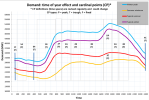
The grid has to be able to supply about 52 GW for the evening peak in "average" winter, higher when it is very cold.
You can clearly see that overnight the "spare" capability of the grid is something like 52-31 = 21GW (in winter, more in the other seasons)
Other people have done the working, so I'm not going to, which says there is no problem charging EVs because so much of the charging of them is done when electricity is cheaper and that is when "time of use" costs are reflecting things like reduced demand and renewables being the source rather than gas.
"Flattening the curve" is the name of the game. Use capacity when it is spare and better still cheap.