EV chat

Similar problem in Notts. Then the cyclists use the pavements instead of the cycle lanes. There's barely a day goes by when a f*@#ing cyclist nearly hits me whilst I'm on the pavement.
That is when you should carry a walking stick that might accidently on purpose get mixed up with the spokes.

"But I'm unsteady on my feet officer, and he pushed me and unbalanced me."
 
. It is perfectly foreseeable that a driver could be in the process of turning across a stream of traffic and then be obliged to stop in the path of traffic. Very, very bad.

However, my main complaint is that pedestrians seem no longer to be responsible for their own safety.
I've seen that happen I try as a pedestrian to let a car that is trying to turn do so if there's a gap in the traffic rather than block the road even longer to let me cross. Drivers don't always take the hint. Common sense required, and there seems to a lack of that these days - especially with whoever wrote the new Highway Code.
I'm always responsible for my own safety. Can't say the same about anyone else.
 
A little bit of the enjoyment I will concede is what you could call laziness, but actually being able to moderate your speed on approach to a bend and accelerating out of it with one flowing movement on one pedal is quite nice
Personally I found it quite nice, when in the mood, to use a bit of skill, use the brakes to moderate the speed, coming off them in a smooth way timed to balance the car for the corner, in conjunction with a nice heel and toe change for a flowing corner. But each to his own.

That depends what kind of driving experience you call "nicer". If that's the kind of "nicer" you want, I guess you're the sort who regards driving as an inconvenience and are first in the queue for a self-driving car. Of course, ones experience of driving is coloured by living in a metropolis!
Struck me that way too.

Mine has an 8 speed DCT gearbox and I swear that it can anticipate what I am going to do and it changes cogs extremely swiftly - barely perceptual in comfort mode then by the time you get to the full blown top sport mode rather aggressively with that little nice nudge you feel against your back.
Yes, for anyone that hasn't driven one DCTs are an entirely different animal to a slushbox. They are incredibly seamless and fast. The flow of power really has to be experienced (I haven't driven an EV but I suspect they are similar). And they do anticipate - the transmission control unit anticipates based on inputs from the various sensors in the car because they line up in advance the next gear they believe will be selected; all the gearbox has to do then is to engage the clutch for that shaft as it dis-engages the clutch for the other shaft (the gear it was in). They are completely responsive to the load and shift down immediately to go up a hill, which I have to say is a brilliant sensation. In mine (which is a very old model) it doesn't do the same downhill, so to get engine braking if driving in hilly b-roads I will either shift down with a paddle (or alternatively put the box into manual mode and use the lever as a sequential shifter) or simply put the box into sport mode which then holds the revs for longer. I miss the skill of sporty manual changes but the DCT (or DSG or whatever your manufacturer calls it) is a compelling experience. It's neither better nor worse, equally good, just different.
 
conjunction with a nice heel and toe change for a flowing corne
Not done that for years now - I remember I used to and actually failed my first driving test! When I took some professional lessons subsequently, the instructor immediately asked "did you change gear using that method on your test?" - when I replied in the affirmative he said "that's why you failed then - the examiner thought you were being a flash b****r!" My excuse - it was in a pretty ancient Morris Minor Series II and the synchromesh was a little tired!

Yes, for anyone that hasn't driven one DCTs are an entirely different animal to a slushbox. They are incredibly seamless and fast. The flow of power really has to be experienced (I haven't driven an EV but I suspect they are similar). And they do anticipate - the transmission control unit anticipates based on inputs from the various sensors in the car because they line up in advance the next gear they believe will be selected; all the gearbox has to do then is to engage the clutch for that shaft as it dis-engages the clutch for the other shaft (the gear it was in). They are completely responsive to the load and shift down immediately to go up a hill, which I have to say is a brilliant sensation. In mine (which is a very old model) it doesn't do the same downhill, so to get engine braking if driving in hilly b-roads I will either shift down with a paddle (or alternatively put the box into manual mode and use the lever as a sequential shifter) or simply put the box into sport mode which then holds the revs for longer. I miss the skill of sporty manual changes but the DCT (or DSG or whatever your manufacturer calls it) is a compelling experience. It's neither better nor worse, equally good, just different.
Very well explained - far better than my previous ramblings! :o_O:

I don't often use manual mode so on the odd occasion I don't remember which is + or -, it soon lets me know of course and luckily it will not change down if that would exceed the max rev limit :oops:
 
...the transmission control unit anticipates based on inputs from the various sensors in the car because they line up in advance the next gear they believe will be selected; all the gearbox has to do then is to engage the clutch for that shaft as it dis-engages the clutch for the other shaft (the gear it was in). They are completely responsive to the load and shift down immediately to go up a hill, which I have to say is a brilliant sensation. In mine (which is a very old model) it doesn't do the same downhill, so to get engine braking if driving in hilly b-roads I will either shift down with a paddle (or alternatively put the box into manual mode and use the lever as a sequential shifter) or simply put the box into sport mode which then holds the revs for longer. I miss the skill of sporty manual changes but the DCT (or DSG or whatever your manufacturer calls it) is a compelling experience. It's neither better nor worse, equally good, just different.
And that is why the current price difference between ICE & EV can't last in the long term. To get performance from ICE requires such high standards of engineering and complexity to compensate for the inherent limitations.

In order to turn an engine, which inherently exhibits most of its power in a limited range of revs, into something which approximates to power at any speed, there's all that clutter of gearbox complexity and control. Lots of metal pounding around in the engine, timed explosions, precision injection of single-use fuel with air and throw the mess out the back. Meanwhile that uppy-downy motion has to be converted to rotary motion. The the wrong rotational speed bits have to go through an abundance of gears (4 6ths of which are not doing much at any time) in order to get the wheels moving at the right speed, whilst juggling the ratio of gearing to still provide torque.
Urgh.
Electric motor rotates. Reduction gear does one scaling from high motor speed to much lower wheel speed. All solid-state, no moving parts electronics controls the speed of the motor, from various electronic inputs (as above).
Going down or uphill can have a uniform degree of engine braking without that complex mechanical gear stuff.... and it fills the tank as you go down hill.

I get that there can be some fun and theatre from the noise and the activity of gear changes. But I reject the attempts to characterise "enjoyment" of EV as lazy, or that I would prefer a self-driving car. I like it putting a smile on my face for being more fun than the past Ford Focus or even my Mini Cooper S (in a different way). Being able to complete a 3-4 hour journey on motorway and A-road (not just boring town traffic) and still feel quite lively, without feeling a bit exhausted is rather nice!
Some of these arguments are favouring ICE for ICE sake (the noise and mastery), that really isn't what 90% of drivers get in their car for. It is just the box that gets them and their family from A to B, perhaps indulging their ego a bit with the brand or the experience.
My main contention is that a lot of ordinary people have yet to discover how convenient, and nice EVs are to drive. Paying attention to the superiority of a DCT gearbox is only addressing the few percent of drivers on the road, nevertheless, that smooth, eager power is available to almost any EV driver. Maybe the power will be reduced a bit in the future, it is often unnecessary, but gearless torque can be had in an EV without the complexity/cost of DCT.

This post started as a reply to the complexity of achieving what an EV does inherently (torque all the way). The prices are all wrong at the moment, but the build simplicity and service simplicity are obvious. A reduction gearbox is just so much simpler to build or maintain than DCT. The motor is so much simpler than any number of pistons. The running environment is less hostile than boiling temperatures. There are many systems which are still the same or similar for complexity, the drive train, breaking, 12V electronics, the cooling (which now has to cool a battery at around 30C instead of near boiling vibrating thing.

The higher costs of insurance affecting all modern cars is the result of the changing technology we put into them all. Where once a fuel or oil pressure gauge could cost a few quid to replace and hundred for labour to fit it, now any car can expect hundreds for the replacement of some extravagant wrap-around instrument-cluster, come infotainment, come navigation. Electric seats. And speaking of stupid laziness - electric boots!

For most "ordinary" drivers, they will eventually, resentfully, end up buying an EV. When they do, they will wonder why they didn't sooner and why they clung onto the FUD about not enough public chargers, they never work, the batteries die at the end of warranty, the car will be worth nothing for resale. They may have bought a 5 year old second hand MY2026 EV with undiminished range at a price competitive or far better than the MY2026 ICE which is more expensive to run and expensive to maintain. Depending on where they live, petrol stations might be closing down and it getting more difficult to find fuel for, even if we are still a few years from needing apps to locate fuel stations for dino-juice.

Yeah some will continue to enjoy the noisy drama, just like I'm sure there are people who like winding up a watch, enjoy the sound of a modem connecting, or making beds with sheets and blankets and making a tidy job of tucking in the corners :D
 
I have nothing against EVs except I have nowhere to charge one. Also all recent cars are huge and won't fit in my garage, my 2002 Mini Cooper S fits quite nicely whereas current Minis ICE or EV won't. My plan is to run my current car until I retire and move house, at which point a larger garage with power to charge my car are part of my requirements. My current garage is in a separate block with no power.
 
Like I said (or you might have to read between the lines), if all you want to do is stop-start around town, EV is ideal*. Out of town, if you can't tell the difference, well good for you.

One pedal? No! Don't you realise that in one-pedal mode, when you lift off even a little the brake lights come on? I want to coast with minimal engine braking (ie no regen), and brake when I choose not simply because I've lifted my foot. That's driving for morons (and we don't want morons on the road at all).

* with all the fecking "aids" turned off.
 
One pedal? No! Don't you realise that in one-pedal mode, when you lift off even a little the brake lights come on? I want to coast with minimal engine braking (ie no regen), and brake when I choose....
That is patent nonsense. There is a specification for the degree of deceleration which must trigger the brake light in normal breaking. It is definitely not on the slightest deceleration.
Just as there is a specification for all modern cars for when the brake lights should flash in extreme braking.

BTW I use the paddles on my car to reduce the regen level when on open roads and wanting less (or no) regen.
Electronics makes such matters possible... Oh yeah, I know, you can drop a gear to get more engine breaking (I have been driving manual ICE for 45 years to understand that).
Nevertheless, "breaking" with the engine is using fuel and breaking with the brakes is using fuel AND wearing break pads and dropping break dust. Today's technology recovers the kinetic energy as stored power, rather than making waste heat.
(I think it was somewhere like Mount Equinox in the USA, where the descent road had warning notices to drivers to select a lower gear and not overheat their brakes going downhill. Friction & heat to slow... how quaint!
 
Being able to complete a 3-4 hour journey on motorway and A-road (not just boring town traffic) and still feel quite lively, without feeling a bit exhausted is rather nice
Surely that depends on the vehicle and not how it happens to be powered - if it is comfortable, supportive seats, suitable driving position and reasonably quiet etc. then that is important? The powertrain or motive force does not really enter into the equation? Some time ago I had a Rover 75 firms car (Diesel 👿) and apart from those qualities I mentioned it was, for some reason, the least tiring long distance car I had experienced and I regularly did day round trips to West Wales or the extremes of Cornwall, plus multiple hours on site, from my base at the time in North Somerset, and I felt quite refreshed after getting home at the end of the day.

What does seriously concern me is that the plethora of driving aids, Radar Cruise control, Lane keep assist, Lane Follow etc. etc combined with your touted "one pedal driving" for go or slow can easily encourage a severe lack of attention or observation through boredom, familiarity or taking in the scenery etc. One of the reasons that I will often use my DCT in manual mode, especially if I am on a fairly long trip, which at least helps to maintain my interaction with the control of the vehicle. It goes without saying that all the other mentioned superfluous "frills" are permanently turned off - a possibility on my vehicle thankfully but on many newer vehicles some you can't turn off and even if you can, they default to on again every time you start the engine.

I shan't bother replying to any of your other slightly erroneous or ridiculous (making beds?) comments in another of your long posts, life's too short. You are obviously fanatical about EVs and that is fine - it just seems that you have to have the last argumentative word when anybody suggests a perfectly sensible alternative viewpoint.

It's a free choice, at least at the moment, whatever floats your boat! It's a forum, where all views are welcome I believe.
 
Last edited:
There is a specification for the degree of deceleration which must trigger the brake light in normal breaking. It is definitely not on the slightest deceleration.
Have you never been in a "train" of cars just cruising along at a constant rate, and wondered why some cars show brake lights from time to time while others don't? It's the lack of fine feathering from EVs and automatics.

I agree with woodbar – you're clearly unable to see any defect with your very expensive EV.
 
Surely that depends on the vehicle and not how it happens to be powered - if it is comfortable, supportive seats, suitable driving position and reasonably quiet etc. then that is important? The powertrain or motive force does not really enter into the equation? Some time ago I had a Rover 75 firms car (Diesel 👿) and apart from those qualities I mentioned it was, for some reason, the least tiring long distance car I had experienced and I regularly did day round trips to West Wales or the extremes of Cornwall, plus multiple hours on site, from my base at the time in North Somerset, and I felt quite refreshed after getting home at the end of the day.

What does seriously concern me is that the plethora of driving aids, Radar Cruise control, Lane keep assist, Lane Follow etc. etc combined with your touted "one pedal driving" for go or slow can easily encourage a severe lack of attention or observation through boredom, familiarity or taking in the scenery etc. One of the reasons that I will often use my DCT in manual mode, especially if I am on a fairly long trip, which at least helps to maintain my interaction with the control of the vehicle. It goes without saying that all the other mentioned superfluous "frills" are permanently turned off - a possibility on my vehicle thankfully but on many newer vehicles some you can't turn off and even if you can, they default to on again every time you start the engine.

I shan't bother replying to any of your other slightly erroneous or ridiculous (making beds?) comments in another of your long posts, life's too short. You are obviously fanatical about EVs and that is fine - it just seems that you have to have the last argumentative word when anybody suggests a perfectly sensible alternative viewpoint.

It's a free choice, at least at the moment, whatever floats your boat! It's a forum, where all views are welcome I believe.
Apologies for some of the snark. No really!
You are quite right about the many other factors about a car being responsible for how you feel both during the journey and at journey's end.

I wouldn't characterise myself as fanatical, but I think everyone here dislikes unfairness or inaccuracy. What I read so often (and in here) were repeats of old tropes which are simply not true or no longer true.
A conspiracy prone person would say that it is media mischief doing the will of fossil fuel paymasters, but mostly I think the real reason is that the press and social media like clickbait titles which they know a "sceptical" reader will self-select to reinforce their prejudice. It's just a desire to get clicks. Nevertheless, it does keep 10 and 15 year old problems alive, long after they are gone. Early EVs which cooked their batteries because they had no liquid cooling, so a fast journey with severa stops at rapid chargers would do harm. Old news that a high proportion of chargers are broken. That had a certain truth before I bought in 2021 and single unloved units were quite common. Most new installations from 2021 onwards are of several units (or lots), so the prospect of reaching a lone and dead rapid has gone - but the assertion that (a) there are nowhere near enough and (b) working ones are difficult to find is clinging old bad news as a story... that can be found in the history of this thread and I dare say is a sort of "fanatical" propagation of anti EV views. I'm sure you didn't intend to say that fanatical dismissal of EVs is fine, but fanatical promotion of EVs is not.
I went to bed having made that post and wishing that I hadn't, actually. Because I seemed to just be turning up the gain on the argument.

Sheets & blankets and tucking in corners was a really weird one... I was searching for things of the past that people might have an irrational nostalgia for, like the times before the convenience of a duvet.
I can admire the pinnacle of mechanical engineering that it represents for personal transport, but IMHO its time is up (or will be).

I was one person levelling the playing field against several months of prejudice and spun old news. For that I'm not sorry, for the snark I am.
 
Don't you realise that in one-pedal mode, when you lift off even a little the brake lights come on? I want to coast with minimal engine braking (ie no regen), and brake when I choose not simply because I've lifted my foot. That's driving for morons (and we don't want morons on the road at all).
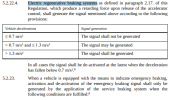
Ah, it is morning and I've found the reference. I had squirrelled it away, because I was worried when we first started driving the car, what were the brake lights doing. Here's the specification...

From: UN Regulation No. 13-H
"Uniform provisions concerning the approval of passenger cars with regard to braking"
(Page 21)

Oh FFS - I'm still getting:
1775552599213.png

So here's a link which needs a bit of obvious editing to paste into a browser tab
h-t-t-p-s://unece.org/fileadmin/DAM/trans/main/wp29/wp29regs/2018/R013hr4e.pdf

A snip from the PDF:

1775552363679.png
My calculation of m/s/s to mph/s decelerations was 0.7 = 1.56 mph/s; 1.3 = 2.91 mph/s

Some time later I bought an OBD2 diagnostic port plug so I could take a look, when my partner was driving.... 'cos I'm an interested engineer.

"Driving for morons" - polite? Snark?
 
Reading some of the various comments about braking and whether or not the lights are on ( :rolleyes: ) reminded me of the fact that when travelling in a line of vehicles it amazes me just how many drivers are continually using their brake pedal to control their vehicles speed and closeness to the vehicle in front of them? I was always taught, and still adopt, the method of keeping a suitable distance from the car in front and maintaining this modulating your speed using the throttle and NOT by use of the brake pedal unless that becomes necessary for changing conditions.

Sometimes, just for fun really, I will count the number of brake applications of the preceding vehicle for a while - it can get pretty silly - me once, vehicle in front 15 -20 times! Of course this can be caused by a lack of anticipation, traffic lights or a bend etc., but mostly by following too closely! I just think they will pay for it one way or another, hopefully by only needing frequent discs/pads changes?
 
I was always taught, and still adopt, the method of keeping a suitable distance from the car in front and maintaining this modulating your speed using the throttle and NOT by use of the brake pedal
Quite so. Some people seem to think if they have not got pressure on the go pedal they must press the stop pedal. I don't know if they get taught this or just develop it as a bad habit.
Sometimes, just for fun really, I will count the number of brake applications of the preceding vehicle for a while - it can get pretty silly - me once, vehicle in front 15 -20 times!
I do the same sometimes. Once I was following somebody and she was constantly on and off the brakes. I didn't touch them once.
At my last service I was told I'd need the pads etc. changed in 2500-3000 miles. I stretched it a bit to 4000 and when it went in for the MoT a month ago I asked them to do the brakes as they'd advised. They told me when I went to collect that they hadn't done them and the brakes are probably good for another 3000 miles. So I'll leave it till the next service and see what they say.
Most of my miles are motorway so I hardly touch the brakes (as I almost never travel when it's busy) - I've done 76K and I think I'm still on the original set (can't check the bills at the moment). I don't know whether that's good, but it sounds like it to me.
 
Back
Top